Why Your Squash Grip Changes Between the First and Fifth Game
Quick Answer: Grip changes late in a match come from three things stacking up: sweat lowering friction, fatigue pushing you to squeeze harder to compensate, and forearm swelling subtly changing how the handle sits in your palm. The fix is not a tighter grip. It is a fresh overgrip at the right thickness, a deliberate relax-between-rallies habit, and choosing shots that do not demand fine wrist control once you are tired.
Game one, the ball comes off the strings exactly where you meant it to.
Game five, the same swing sends it two feet wide, and you blame your legs.
It usually is not your legs.

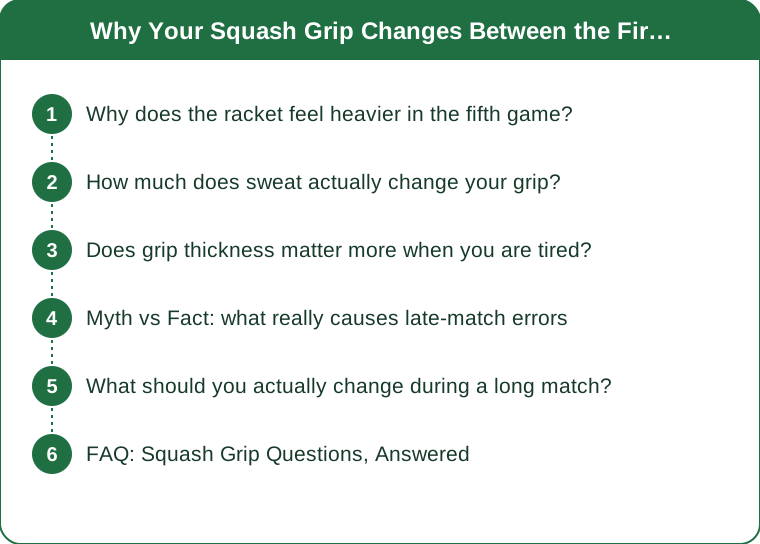
Why does the racket feel heavier in the fifth game?
It weighs the same. What changed is how much of your forearm is available to control it.
A squash racket is roughly 120 to 145 grams, which is trivial to hold and surprisingly demanding to hold precisely. Precision comes from the small muscles in your forearm making constant micro-corrections. Those muscles fatigue on a different clock than your legs do, and they fatigue faster when they have been gripping hard for forty minutes.
The practical signal is that your errors change character. Early-match errors are usually positional, meaning you were late to the ball. Late-match errors are usually face-angle errors, meaning you arrived fine and the racket face was open or closed by a few degrees at contact. A few degrees is the difference between a tight rail and a loose ball sitting up in the middle.
How much does sweat actually change your grip?
More than most players expect, and it happens in a specific order.
A dry towelling grip has high friction, so you can hold it loosely and still control the face. Once it saturates, friction drops and the handle starts to rotate very slightly in your hand at impact. Your nervous system notices, and its default response is to squeeze harder — which is exactly the response that accelerates forearm fatigue.
So you get a loop: wet grip, tighter squeeze, faster fatigue, less fine control, tighter squeeze again.
The interruption is mechanical, not mental. Carry two spare overgrips in your bag and change one at the between-games break if the current one feels slick. It takes about forty seconds and it resets the friction side of the loop entirely. A wristband is not a substitute; it catches forearm sweat travelling down, not palm sweat, which is where the problem is.
Does grip thickness matter more when you are tired?
Yes, and it is the adjustment most club players never make.
A handle that is slightly too thin forces your fingers to close further, which requires more active muscular effort to hold steady. Fresh, you never notice. Deep into a match, that extra effort is the thing that runs out.
A reasonable check: hold the racket in a normal grip and look at whether the tip of your ring finger touches the base of your thumb. Light contact is about right. If your finger overlaps well past the thumb pad, the handle is likely too thin for you, and building it up with one extra overgrip layer often does more for your late-match control than any technique cue.
Going too thick is a real risk in the other direction, because it slows down grip changes between forehand and backhand. Change one layer at a time and give it two or three sessions before judging.

Myth vs Fact: what really causes late-match errors
Myth: A firmer grip gives you more control. Fact: Control comes from a stable wrist, not a clenched hand. Elite players hold relatively lightly and firm up only at contact. Constant squeezing fatigues the exact muscles that stabilise the wrist.
Myth: If your shots get loose, you need to swing harder. Fact: Loose shots late in a match are usually a face-angle problem. Swinging harder amplifies the same angular error and sends the ball further off target.
Myth: Grip fatigue is a strength issue, so grip trainers will fix it. Fact: Crushing-grip strength and sustained low-level control are different qualities. Most players get more from reducing unnecessary squeeze time than from adding grip strength work.
Myth: Your grip is a fixed thing you set once as a beginner. Fact: Hand size, glove-free playing, humidity, and handle wear all change what works. Grips are worth re-checking once a season.
Myth: Sweaty hands are just something you tolerate. Fact: Grip material, replacement frequency, and a small towel at the back wall are all controllable. Most club players simply never change the grip until it is visibly shredded.
What should you actually change during a long match?
Three habits, in order of how much they return for the effort.
Relax between rallies. The moment the rally ends, open your hand fully and let the racket hang from your fingers while you walk back. Even five to eight seconds of complete release, done every rally, adds up to several minutes of recovery for muscles that otherwise never switch off.
Change the overgrip at the break. Do it at 2-1 or 2-2, not when it is already unplayable. You are pre-empting the friction drop, not reacting to it.
Shift your shot selection as you tire. Late in a match, favour length over touch. A straight drive to the back is far more forgiving of a small face-angle error than a tight drop, because the target is deeper and larger. Save the drops for the points where you have genuinely opened the court and have time to set the face.
One more, on the training side: if your forearm is the first thing to go, add two sets of ghosting with a slightly heavier racket at the end of a session once a week. You are training the control muscles under fatigue, which is the state they actually fail in.
FAQ: Squash Grip Questions, Answered
Should I wear a glove for squash?
Most players should not. Squash rules allow gloves, but they add a layer between your fingers and the handle, which dulls the feedback that lets you feel the face angle. If your hands sweat heavily, a tacky replacement grip plus frequent overgrip changes is usually the better route.
How often should I replace my overgrip?
If you play twice a week, roughly every three to four weeks, and sooner in humid conditions. The signal is feel, not appearance: once it stops feeling slightly tacky when you first pick it up, it has stopped doing its job.
Is a continental grip really necessary?
A slightly open, continental-style grip is the standard for a good reason — it lets you play both forehand and backhand without changing grips, and it opens the face for the cut you need on drops and boasts. If you are gripping like a tennis forehand, your backhand will fight you all match.
TL;DR:
- Late-match errors are usually face-angle errors from forearm fatigue, not fitness or footwork failures.
- Sweat drops grip friction, which triggers a harder squeeze, which accelerates the fatigue — break the loop by changing the overgrip mid-match.
- A handle that is slightly too thin costs you control specifically when tired; check the ring-finger-to-thumb contact and build up one layer if needed.
- Open your hand fully between rallies, and shift toward length over touch as the match goes long.
None of this makes you fitter, and that is rather the point. Most players spend their off-court effort on legs and lungs while quietly losing games to a piece of towelling that stopped gripping in the second game. Fix the cheap thing first, then go and do the running.
Keep Reading
This article is for general informational and styling purposes only. Fit, sizing, and product availability may vary.