How Often Should You Restring a Squash Racquet?
Quick Answer: The old rule is to restring as many times per year as you play per week — twice a week means twice a year. That is a reasonable floor, but tension loss, not breakage, is what actually costs you performance. Strings lose the majority of their tension in the first two weeks after stringing, then continue to decline steadily, so a competitive player benefits from restringing every 30 to 40 playing hours regardless of whether anything has snapped. Waiting for a break means playing the last two months on strings that have quietly stopped doing their job.
You have never restrung it. It has not broken. It seems fine.
It is not fine, and the reason is that the change happens slowly enough that your technique compensates for it without you noticing. By the time you finally do restring, the difference in the first rally is startling — which tells you what you had been playing with. The tell in the third section is how to catch it long before that.

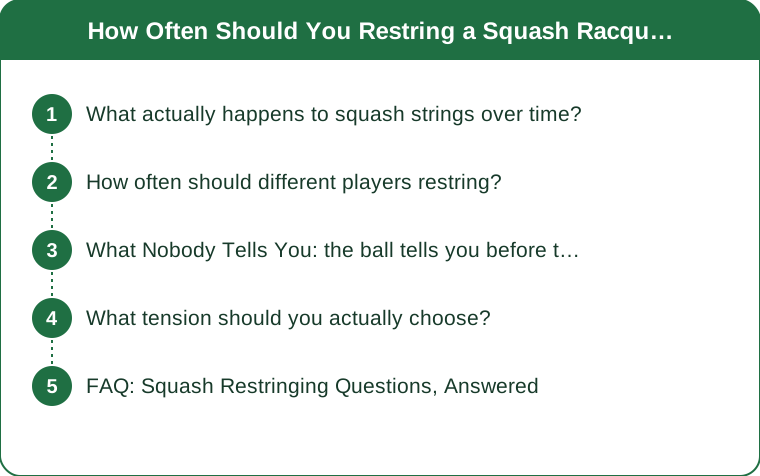
What actually happens to squash strings over time?
Two separate processes, and only one of them is visible.
Tension loss starts immediately. A freshly strung racquet loses a substantial share of its tension in the first 24 to 48 hours simply from the strings settling, and continues to lose it steadily with every impact. Rough figures: a racquet strung at 26 lbs may be sitting closer to 22 or 23 within a couple of weeks of regular play, and lower still after a couple of months.
Notching and fiber fatigue happen more slowly. The main and cross strings saw against each other at every impact, cutting notches into the string. You can see and feel these — run a fingernail along the strings near the center of the string bed and you will feel the grooves. Notching is what eventually causes the break.
The important point: tension loss affects your game long before notching causes a failure. Lower tension means more power and less control — the ball leaves the strings faster and with a less predictable direction. In squash, where accuracy into the back corners and along the wall is what wins rallies, that trade is a bad one.
Squash strings are thinner and softer than tennis strings, so they both play better and degrade faster. This is a design choice, not a flaw.
How often should different players restring?
The classic formula
Restring per year as many times as you play per week. Twice a week, twice a year. Four times a week, four times a year.
It is a fine baseline for recreational players and it systematically under-serves anyone competitive.
The better framework: playing hours
Every 30 to 40 hours of play for anyone who cares about the quality of their shots. For a player doing two 90-minute sessions a week, that is roughly every 10 to 13 weeks.
Adjust for a few factors:
Hard hitters and players who hit a lot of drives wear strings faster and should be at the shorter end.
Players who mishit frequently, which includes most beginners, break strings on the frame edge more often — but for beginners, string performance matters less, so the classic annual formula is genuinely adequate.
Natural gut and softer multifilaments lose tension faster than stiffer synthetics but play noticeably better. If you use a premium multifilament, restring more often to get what you paid for.
Anyone playing in a cold court should note that tension behaves differently with temperature, which is worth knowing at the start of the indoor season.
If you never play competitively
Once a year is fine, or when it breaks. You are unlikely to feel the difference in a social game, and there is no benefit to spending money to chase a precision you are not using.

What Nobody Tells You: the ball tells you before the strings do
There is a simple diagnostic that does not require touching the racquet.
Your length is going long. As tension drops, the string bed becomes more of a trampoline and returns more energy to the ball. Drives that used to die in the back corner start coming off the back wall and sitting up for your opponent. If your length has quietly deteriorated over a few weeks with no change in technique, check the strings before you change your swing.
The related symptom: you find yourself hitting softer to control the ball. That is your body compensating for a livelier string bed, and it costs you pace when you need it.
Two physical checks worth doing monthly:
The push test. Press your thumb into the center of the string bed. Fresh strings at proper tension feel firm and give very little. Strings well past their useful life feel soft and depress easily. Once you have felt the difference twice, it is instantly recognizable.
The pluck test. Pluck the center main strings and listen. A higher pitch means higher tension; a dull, low thud means the tension has gone. This is imprecise but works well as a comparison over time — do it the day you restring so you know what fresh sounds like.
The visual check: look for notching where the mains cross the crosses, and look for fraying. Visible fraying means a break is coming within a few sessions. That is the point to book the restring rather than waiting to be surprised mid-match.
One habit worth adopting: write the date on the frame with a marker, or take a photo of your phone calendar the day you restring. Almost nobody remembers accurately, and it is the difference between a decision based on data and a guess.
What tension should you actually choose?
Most squash racquets sit somewhere between 22 and 30 lbs, and the tradeoff is consistent.
Lower tension — around 22 to 25 lbs: more power, more trampoline, a larger sweet spot, and more comfort. Good for players who need help generating pace, for beginners, and for anyone with elbow or wrist problems.
Higher tension — around 26 to 30 lbs: more control, better feel and touch, more precise directional accuracy, and less power. Better for advanced players and anyone whose game is built on length and tight drops.
Most club players land at 25 to 27 lbs, and it is a sensible default if you are unsure.
Two practical points:
Stringing tension is a starting point, not a setting. Because tension drops fast, a racquet strung at 28 spends most of its life somewhere in the mid-20s. Some players deliberately string a couple of pounds higher than their target to spend more time near it.
Change one variable at a time. If you change string type and tension together, you will not know which produced the difference. Restring with the same setup twice before adjusting anything, so you know what your baseline actually feels like.
FAQ: Squash Restringing Questions, Answered
Should I restring if I have not played all summer?
Yes, if the racquet was strung before the break. Strings lose tension while sitting in the bag — less than through play, but meaningfully over three or four months, and unevenly. Starting the indoor season on old strings is a common reason people feel off in their first few weeks back and blame their form.
Is it worth learning to string my own racquet?
Only if you play a lot and own multiple racquets. A machine costs several hundred and the learning curve is real. For two or three restrings a year, a good local stringer is better value and better quality.
Do broken strings damage the frame?
They can. A broken string leaves the remaining strings pulling unevenly on the frame, which puts asymmetric stress on it. Cut the remaining strings out promptly rather than leaving a racquet with one string broken in your bag for a month — a few seconds with scissors protects a much more expensive item.
TL;DR:
- Tension loss, not breakage, is what costs you performance — strings shed most tension in the first two weeks and keep going.
- Restring every 30 to 40 playing hours if you are competitive; once a year is fine socially.
- The earliest sign is your length going long and you compensating by hitting softer.
- Check with the push test and the pluck test monthly, and write the restring date on the frame.
If you cannot remember the last time you restrung it, that is the answer. Book it, and notice what your first drive does.
Keep Reading
This article is for general informational and styling purposes only. Fit, sizing, and product availability may vary.