How to Play Someone Much Better Than You Without Wasting the Session
Quick Answer: A straight match against a much stronger player produces short rallies, and short rallies mean almost no practice. Change the format instead: play conditioned games, handicap the scoring, or use half the court - all of which extend rallies and keep both players working. The goal is time on the ball, not a competitive scoreline. Ask for a conditioned game, not a normal one.
A one-sided match gives you thirty seconds of useful squash in an hour.
Almost any other format gives you thirty minutes.

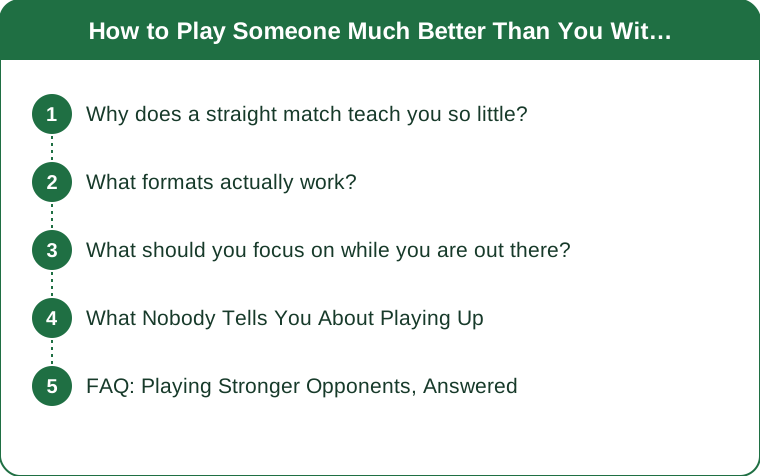
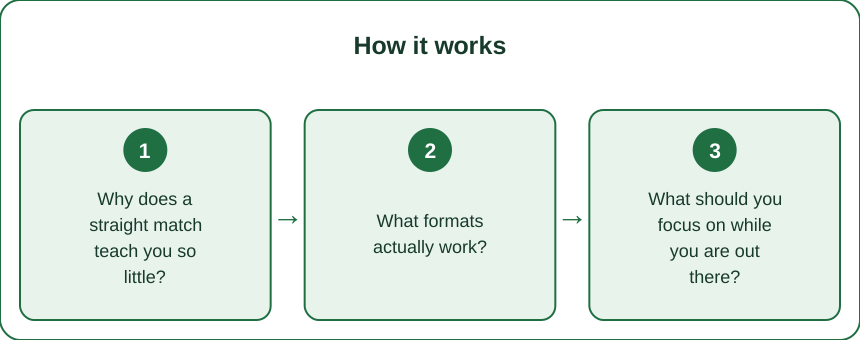
Why does a straight match teach you so little?
Because it removes exactly the situations you need to practise.
Rallies end too quickly. Against a much stronger opponent, the point often ends on the second or third shot - so you never reach the phase of a rally where positioning, recovery, and shot selection actually matter. You are practising the start of rallies and nothing else.
You spend the match retrieving, not constructing. Being under constant pressure means every shot is defensive, and you never rehearse the thing you are trying to learn: building a rally and creating an opening.
Your movement pattern gets worse, not better. Lunging desperately for balls you cannot reach ingrains poor recovery habits and increases injury risk. Practising bad movement is worse than not practising.
And the stronger player is not getting much either. They are hitting winners rather than working, which is neither training nor particularly enjoyable after the first game.
Confidence takes a real hit too. A run of heavy defeats affects how willingly you attempt anything, and tentative squash is slow squash.
None of this is about the gap itself. The gap is fine - the format is the problem, and it is entirely within your control to change.
What formats actually work?
Four, each solving a different part of the problem.
Conditioned games are the best single option. Restrict the stronger player - straight drives only, no shots in front of the service line, or must hit behind the service box. The restriction extends rallies dramatically while still letting them play at pace, and you get a genuine workout in the back corners.
Handicap the score. Start each game at 0-6 in your favour, or require them to win by a larger margin. This keeps the competitive tension real, which matters more for the quality of your play than people expect.
Play half-court games. Both players restricted to one side of the court. Rallies get long, movement is intense, and the tight straight game is where most improvement lives anyway.
Do a feeding session instead of a game. They feed you a consistent ball to one corner for five minutes while you work on one shot, then swap. This is where technique actually changes - matches reinforce what you already do.
Combine them across an hour. Fifteen minutes of feeding, twenty minutes of conditioned games, and then a short handicapped match at the end. The match is the reward, not the session.
And ask directly. Most stronger players are happy to do this and simply default to a normal match because nobody suggested anything else.

What should you focus on while you are out there?
One thing, chosen in advance, and judged on execution rather than the point.
Pick a single target for the session. Length, or returning to the T, or hitting straight rather than across. Two targets is one too many and produces attention to neither.
Judge yourself on the process, not the rally outcome. Did you get back to the T. Was the ball tight. Against a stronger player, you will lose rallies you played correctly - and if losing the rally counts as failure, you will learn nothing.
Watch what they do between shots, not during them. The biggest gap between levels is recovery and positioning, not shot power. Where they stand after hitting is more instructive than the shot itself.
Ask one question at the end, not throughout. What is the one thing I should work on. A single specific answer from a stronger player is worth several sessions of guessing.
Notice which of your shots they attack. Anything loose in the middle gets punished immediately, which is precise feedback about which shot is failing under pressure.
And keep a note afterwards. Two lines, immediately after. Session memory fades within a day, and the pattern across five sessions is where the real information is.
What Nobody Tells You About Playing Up
Stronger players usually want to play you, if the format works for them. They get a workout from a conditioned game and very little from an 11-2 win. The framing that matters is asking for a specific format, not asking for a favour.
Your fitness improves faster playing up than playing across. Longer defensive rallies and more court coverage make for a harder physical session than a comfortable match with someone at your level.
You will pick up their habits without trying. Pace of movement, rhythm between points, and where they position themselves get absorbed by proximity. This is real and it is one of the biggest arguments for playing up regularly.
One session a week is the right dose. Playing up exclusively is discouraging and reinforces defensive play. You need matches you can win to practise constructing points, and matches you cannot to raise the ceiling.
Court time matters more than opponent quality. Two hours a week with a mixed group beats one hour with the best player in the club, every time.
And the gap closes in an unexpected order. Movement and fitness improve first, shot quality second, and tactical reading last. If you feel like nothing has changed after two months, check your recovery to the T - it has almost certainly improved, and it is the foundation everything else sits on.
Warm up properly regardless of the format. Squash involves repeated lunging and sudden direction changes, and a cold start is one of the more reliable ways to pick up an injury. This is general information, not medical advice.
FAQ: Playing Stronger Opponents, Answered
Is it rude to ask a better player for a conditioned game?
Not at all, and most will appreciate it. Frame it as what you want to work on - can we do straight drives only for twenty minutes, I am trying to fix my length. That is a clear, easy yes for them.
Should I play up or play down to improve fastest?
Both, deliberately. Playing up raises your ceiling and fitness; playing at or below your level is where you practise winning patterns. A week with one of each is a much better structure than three of either.
How do I stop getting demoralised?
Change what you are measuring. Count rallies over six shots, or times you recovered to the T - metrics you control and can improve within a session. The scoreline against a much stronger player is not information about your progress.
TL;DR:
- A straight match against a much better player gives you almost no useful practice - rallies end too early.
- Conditioned games are the best fix: restrict the stronger player and rallies extend dramatically.
- Handicap scoring, half-court games, and feeding sessions all work for different purposes.
- Pick one focus per session and judge yourself on execution, not on winning the rally.
- One session a week playing up - you need winnable matches too.
Next time, ask for twenty minutes of straight drives only before you play a normal game. It changes the whole hour.
Keep Reading
This article is for general informational and styling purposes only. Fit, sizing, and product availability may vary.