How to Read Your Opponent's Racquet Face Before They Hit
Quick Answer: The racquet face angle at the moment of the backswing gives away direction before contact, and it is far more reliable than watching the ball. Open face pointing toward the side wall means a cross-court; a closed face square to the front wall means straight length; a very open face with a short backswing means a drop. Watching the face rather than the ball buys you roughly 0.2 to 0.3 seconds - which at club level is the difference between arriving in balance and lunging.
Here is how to actually train yourself to see it.

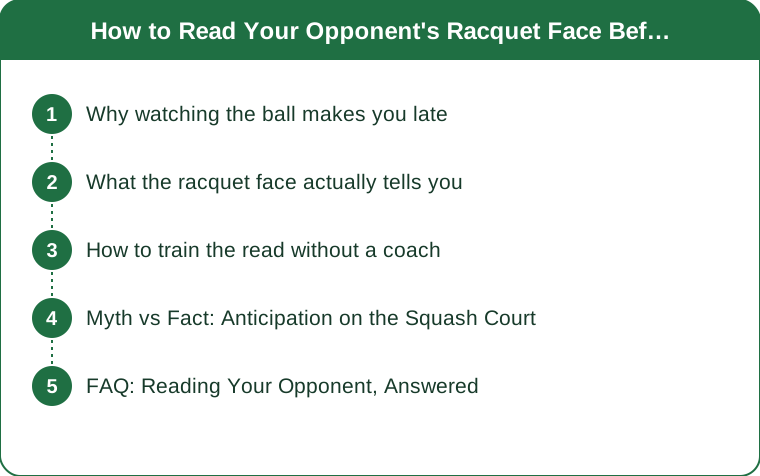
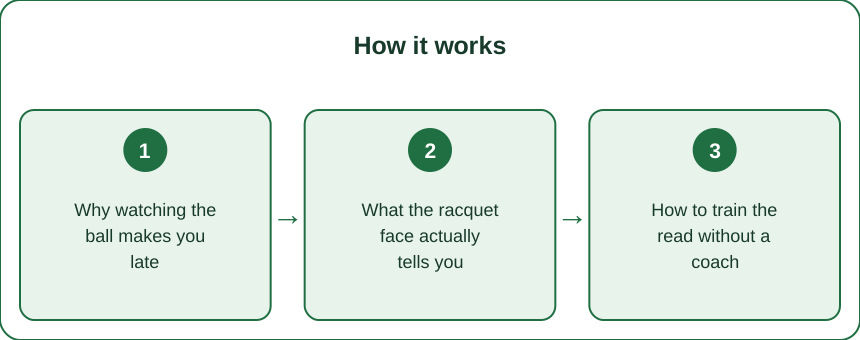
Why watching the ball makes you late
By the time the ball leaves the strings, the information is already old. The ball travels the length of a squash court in well under half a second, so a player who begins moving at contact is starting from behind and spends the rest of the rally catching up.
This is why club players describe good opponents as fast. Most of the time they are not faster - they simply started earlier, because they read the shot rather than reacted to it. Anticipation looks like speed from the other side of the court.
The ball also gives you the least useful information. It tells you where the shot went, which you will find out anyway. The racquet tells you where it is going, and that is the only prediction worth having.
There is a practical test for this. Play a few rallies where you deliberately watch your opponent’s racquet rather than the ball once they are about to strike. You will feel late at first and then noticeably early, usually within one session.
The reason it feels wrong initially is that every racquet sport beginner is told to watch the ball, and it is good advice for contact. It stops being good advice for movement, and separating those two jobs is the whole skill.
Keep watching the ball for your own strike. The switch is: ball while it comes to you, racquet while it goes to them. That alternation is what advanced players do without describing it.
What the racquet face actually tells you
An open face angled toward the side wall means the ball is going cross-court. To hit cross-court, the strings must present a angle across the line of the ball, and that angle is visible in the last portion of the backswing - not just at contact.
A face square to the front wall means straight. Straight drives and straight drops require the strings to stay parallel to the side wall, so the racquet head stays tucked and the face looks flat from where you are standing.
A short backswing with a very open face is a drop or a boast. There is not enough racquet travel to generate length, so what is coming is soft - and your first step should be forward rather than back.
A high early backswing with the wrist cocked usually means length. The preparation for a hard drive is visibly bigger than for anything else, and players almost never disguise it well at club level.
Elbow height is the tell for a lob. Getting the ball high requires the elbow to drop and the face to open dramatically, which is very hard to hide and gives you a full extra beat.
And the shoulders point where the hips point. If a player has rotated to face the side wall, cross-court becomes mechanically awkward - not impossible, but far less likely. Body line is your backup read when the racquet is obscured.
One caveat worth stating. Better players deliberately hold the face neutral until very late, which is exactly what deception means. Against them the read is smaller, but it is not zero - and reading late still beats not reading.

How to train the read without a coach
Start by watching, not playing. Sit and watch two better players for fifteen minutes and call the shot out loud before contact. You will be wrong often at first, and the error rate drops fast because the feedback is instant.
Then do it in a knock-up. During the warm-up, ignore the score entirely and call each of your partner’s shots in your head before they hit. The knock-up is low pressure and has no consequences, which makes it the ideal lab.
Add a conditioned game. Play a game where your opponent may only hit straight or cross-court - no drops, no boasts - so the read is binary and you can build confidence in the cue before adding complexity.
Film a rally on a phone from the back corner. Watch it back and pause a frame before contact. You will see the racquet face clearly in still frames that your eyes skipped over live, and that visual is what sticks.
Practise the split step timing separately. The read is useless without a split step to move from. Land your split as your opponent begins their forward swing - too early and you are flat-footed again, too late and you are still descending when the ball is struck.
Expect a two to three week lag. This is a perceptual skill rather than a physical one, so it improves in steps rather than smoothly - typically nothing for a week, then a session where suddenly you are arriving early.
Myth vs Fact: Anticipation on the Squash Court
Myth: anticipation is guessing. Fact: guessing is committing before information exists. Anticipation is committing after information exists but before the ball does - a completely different thing, and it is why guessers get wrong-footed and readers do not.
Myth: you should never move before your opponent hits. Fact: you should never commit before they hit. Leaning, shifting weight, and starting your split are all correct and cost nothing if you are wrong.
Myth: only advanced players can read the racquet. Fact: club players are the easiest to read of anybody, because they make no attempt to disguise the face at all. The skill is most useful precisely at the level where people assume it is too advanced.
Myth: fast opponents beat you with speed. Fact: most of them beat you with early information. Watch where their eyes are during your swing - the good ones are looking at your racquet, not your ball.
Myth: watching the racquet means taking your eye off the ball. Fact: you alternate. Ball on your own strike, racquet on theirs - the two never overlap, so nothing is lost.
Myth: deception makes reading pointless. Fact: deception delays the read; it does not remove it. A held shot still has to reveal itself before contact, and reading it 0.1 seconds early still beats reading it 0.1 seconds late.
Myth: this only matters at the front of the court. Fact: the biggest gain is on the back-corner decision - whether to drive or boast - because that read determines whether you cover the front at all.
FAQ: Reading Your Opponent, Answered
What is the single most reliable racquet cue?
Face angle relative to the side wall during the last part of the backswing. Open toward the side wall means cross-court; square to the front wall means straight. It is visible even in club-level swings that make no attempt at disguise.
How much time does reading the racquet actually buy?
Roughly 0.2 to 0.3 seconds compared with reacting at contact. On a squash court that is about one full step, which is usually the difference between hitting in balance and lunging.
Will I get wrong-footed more often if I try this?
Occasionally at first, and it is worth it. The fix is to shift weight without committing your feet, so being wrong costs a half step rather than a full recovery.
Does this work against players who disguise their shots?
Less well, but still. Deception delays the moment the face reveals itself rather than eliminating it - so you read later, not never.
How do I know if a drop is coming?
A short backswing with a very open face and a slower racquet head. There is simply not enough swing to produce length, and that shortness is visible from the T.
Should I watch the racquet or the ball during the rally?
Alternate. Watch the ball as it comes to you and up to your own contact, then switch to their racquet as they prepare. The two tasks never happen at the same instant.
How long before I notice a difference?
Most players see it in two to three weeks of deliberate practice, and it arrives suddenly rather than gradually because it is a perceptual skill.
TL;DR:
- The racquet face reveals direction before contact - roughly 0.2 to 0.3 seconds earlier than the ball does.
- Open face toward the side wall = cross-court. Square to the front wall = straight. Short backswing with open face = drop or boast.
- Alternate your focus: ball on your own strike, opponent’s racquet on theirs.
- Club players disguise nothing, which makes this most useful exactly where people assume it is too advanced.
- Train it in the knock-up by calling shots silently before contact - no score, no consequences.
- Land your split step as their forward swing begins, not before and not after.
- Anticipation is not guessing. Shift weight without committing your feet and being wrong costs a half step.
Give it two to three weeks. Perceptual skills improve in jumps, not smoothly - and the jump is usually one session where you notice you are arriving early.
Keep Reading
This article is for general informational and styling purposes only. Fit, sizing, and product availability may vary.