Why Recovering to the T Matters More Than Hitting Harder in Squash
Quick Answer: Recovering quickly to the T (center court position) after every shot wins more rallies than raw shot power, since it minimizes your opponent’s angles and keeps you ready for the next return — most club-level players lose points from poor recovery, not weak shots.
You hit a beautiful, hard shot. Your opponent returns it to a spot you can barely reach. The shot wasn’t the problem — where you were standing after it was.

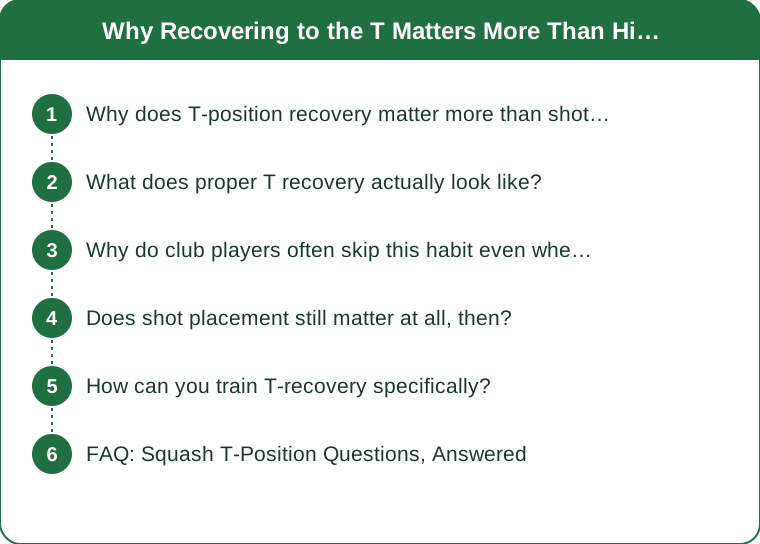
Why does T-position recovery matter more than shot power?
The T is the central court position that gives you the shortest average distance to reach any return your opponent might hit. Failing to recover there after every shot means you’re constantly a step behind on the next shot, no matter how well you hit the previous one, which is why club-level rallies are often decided by positioning rather than raw power.
What does proper T recovery actually look like?
After hitting a shot, the priority is turning and moving back toward center court immediately, watching your opponent’s shot over your shoulder as you go, rather than admiring your own shot or drifting toward the side wall. This habit needs to become nearly automatic, since there’s rarely enough time to consciously think through it mid-rally.
Why do club players often skip this habit even when they know it matters?
Under fatigue or pressure, the tendency is to stay near wherever the shot was just hit, since moving back to center feels like extra unnecessary effort in the moment. This is exactly why T recovery breaks down more in the second half of a match, when fatigue reduces the discipline to move back every single time.

Does shot placement still matter at all, then?
Yes, shot placement absolutely still matters, particularly tight shots along the side wall that limit your opponent’s angles — but the highest-value use of a good shot is that it buys you slightly more time to recover to the T, not that it wins the point outright. Thinking of shots as recovery-enablers rather than point-enders shifts strategy meaningfully.
How can you train T-recovery specifically?
Ghosting drills (practicing movement patterns without a ball, touching the T after simulated shots to each corner) build the muscle memory and conditioning for consistent recovery under fatigue. Adding this to training sessions two to three times a week develops the habit far faster than only playing full games, where the pressure to focus on shot-making often overrides positioning discipline.
FAQ: Squash T-Position Questions, Answered
Is the T position literally always the exact center of the court?
Roughly, yes — it’s the marked intersection near center court, though slight adjustments based on your opponent’s tendencies can shift your ideal recovery spot marginally.
Does T recovery matter as much in doubles or is this singles-specific?
This principle is primarily discussed in singles squash, where covering the whole court alone makes central positioning especially critical.
How long does it take to build automatic T recovery habits?
With consistent ghosting drill practice, most players notice the habit becoming more automatic within 4-6 weeks, though it continues to improve with ongoing match play.
TL;DR:
- T-position recovery wins more rallies than shot power alone
- Turn and move back to center immediately after every shot
- Fatigue is when this habit breaks down most — train it deliberately
- Use shots to buy recovery time, not just to end the point
- Ghosting drills build the habit faster than games alone
Next time you lose a rally to an easy-looking return, check where you were standing — it’s usually the T you skipped, not the shot you hit.
Keep Reading
This article is for general informational and styling purposes only. Fit, sizing, and product availability may vary.