Why Slower Players Beat You More Often Than Faster Ones
Quick Answer: Speed only helps if you have to cover distance, and a player with good length and good T recovery makes you cover far more of it than they do. Slow, accurate players win by hitting deep and tight, returning to the T after every shot, and letting you generate the pace they then redirect. If you keep losing to players you can visibly outrun, the problem is that you are the one running. Fix your length before you work on your fitness.
This is the most common plateau in club squash and it is entirely tactical.
This blog has covered why T-position recovery beats shot power, why your shots die in the middle of the court, and why a well-placed shot can still set up an easy return. This is what those add up to across a whole match.

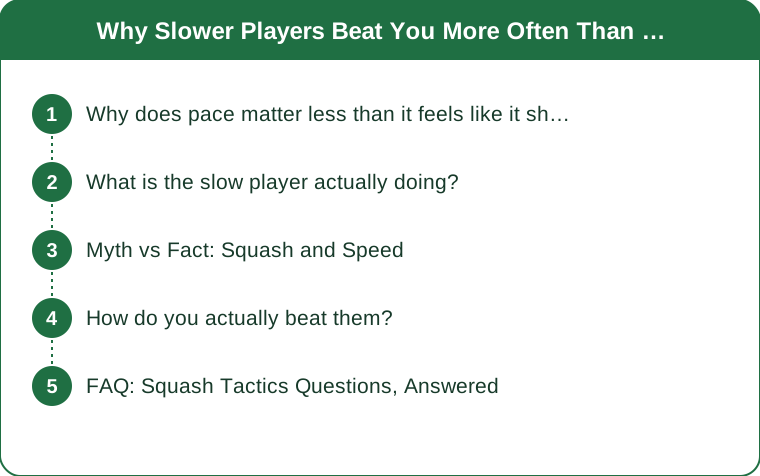
Why does pace matter less than it feels like it should?
Because in a confined court, the ball’s speed is far less important than where it ends up.
The court is a fixed size and the front wall is always the same distance away. Hitting harder does not create more space; it mostly returns the ball to your opponent faster.
A hard shot with poor length gives your opponent a short, high, attackable ball, which is worse than a slow one that dies in the back corner.
Pace is borrowable. An opponent standing on the T with a compact swing can redirect your power without generating any of their own, which is why hitting harder often makes rallies easier for them.
Length forces movement; speed does not. A ball that bounces twice behind the service box makes your opponent travel the full length of the court. A fast ball to the middle makes them take one step.
Every shot you play from the back corner under pressure is a shot you cannot attack from, and good length puts you there repeatedly.
And the physical cost is asymmetric. The player controlling length walks; the player retrieving it sprints. Over forty minutes that gap decides the match regardless of who is quicker over five metres.
What is the slow player actually doing?
A small number of things, consistently, that add up over a match.
They hit to a length rather than to a target. Deep enough that the ball’s second bounce is near the back wall, which removes almost all of your attacking options.
They return to the T after every single shot, which means their average distance to the next ball is short and yours is long.
They keep the ball tight to the side wall, which forces you to play with a restricted swing and reduces the quality of your reply.
They take pace off deliberately. A slower ball gives them more time to recover to the T and gives you less time to set up, which is counter-intuitive but is exactly how it plays out.
They rarely go short from a poor position. Attacking drops only come from the front half of the court and only when they have time, which is why their error count is low.
And they let you make the mistake. A patient length game against an impatient opponent generates unforced errors without the patient player taking any risk at all.

Myth vs Fact: Squash and Speed
Myth: Getting fitter will fix losing to these players. Fact: Fitness raises the ceiling but does not change who has to run. A tactical fix that halves your distance covered is worth more than months of conditioning against this opponent type.
Myth: Hitting harder puts them under pressure. Fact: In a confined court, extra pace mostly returns the ball to your opponent faster and gives you less recovery time. Pressure comes from length, tightness and height variation, not from speed.
Myth: The drop shot is the answer against a slow player. Fact: Only from the front half with time. A drop attempted from the back corner is the single most reliable way to hand a rally to a patient opponent, because a loose short ball is exactly what they are waiting for.
Myth: You should mirror their pace. Fact: You should impose length and vary height, not simply slow down. Slowing down without improving length just makes the rallies longer without changing who is doing the running.
Myth: Winners decide matches at club level. Fact: Unforced errors decide far more of them. Reducing your errors by a handful per game changes outcomes more reliably than adding winners.
Myth: The T is a spot. Fact: It is a moving area that depends on where the ball is. Recovering to a rigid position on the T can be as bad as not recovering at all, because it leaves you flat-footed to the shot they are actually about to play.
How do you actually beat them?
By becoming the one controlling length, then attacking with the space that creates.
Work on length before anything else. The target is a ball that bounces once around the service box line and again very close to the back wall. This one skill changes more matches than any other.
Recover to the T after every shot, without exception. Not walking back after a good shot is the single most common club-level habit that hands rallies away.
Vary height, not just pace. A high, slow lob to the back corner is one of the most difficult balls in squash to attack, and it costs you almost nothing to play.
Attack only from the front half with time. Discipline about shot selection removes most of your unforced errors, which is where these matches are actually lost.
Keep it tight to the side wall. Even an average-length ball that is tight is difficult; a perfect-length ball in the middle of the court is not.
Play the boast sparingly. It brings your opponent to the front and puts you behind them, which is exactly the position a patient player wants you in.
And count your errors for one match. Most players are shocked by the number, and it reframes the whole problem from fitness to selection.
Warm the ball up properly first. A cold ball does not travel to a length no matter how well you hit it, which is a real problem at the start of the indoor season and misleads people into hitting harder than they should.
FAQ: Squash Tactics Questions, Answered
Why do I lose to players who are slower than me?
Because squash rewards position, not pace. A player with good length and consistent T recovery makes you cover far more court than they do, and can redirect your power without generating any of their own. You are losing the movement battle, not the speed one.
Should I hit the ball harder or softer in squash?
Mostly softer and deeper than club players assume. Pace returns the ball to your opponent faster and reduces your own recovery time. Length, tightness to the side wall and height variation create pressure; speed rarely does.
What is the single fastest way to improve at club level?
Length, followed by T recovery. A ball that bounces twice near the back wall removes your opponent’s attacking options entirely, and returning to the T after every shot halves the distance you cover over a match.
TL;DR:
- Pace does not create space in a confined court. Length does, and length is what forces your opponent to travel.
- The patient player wins because you are doing the running. Fix that with length and T recovery, not with fitness.
- Attack only from the front half with time. Loose short balls from the back are what patient players feed on.
- Count your unforced errors for one match. That number, not your winners, is usually the whole story.
The slow player is not beating you with skill you lack. They are beating you with discipline you have not applied yet.
Keep Reading
This article is for general informational and styling purposes only. Fit, sizing, and product availability may vary.