Why Squash Balls Feel Dead at the Start of the Indoor Season
Quick Answer: A squash ball’s bounce depends almost entirely on the temperature of the air sealed inside it, which rises through repeated compression during play. A cold court means a colder starting point, so the ball takes considerably longer to reach playable liveliness — often 8 to 10 minutes rather than 3. It’s not a dead ball; it’s an unwarmed one, and the fix is longer warm-up or a faster-dot ball.
Your first few rallies of the indoor season felt like hitting a stone. The ball is fine. The court is 12 degrees colder than it was in July.

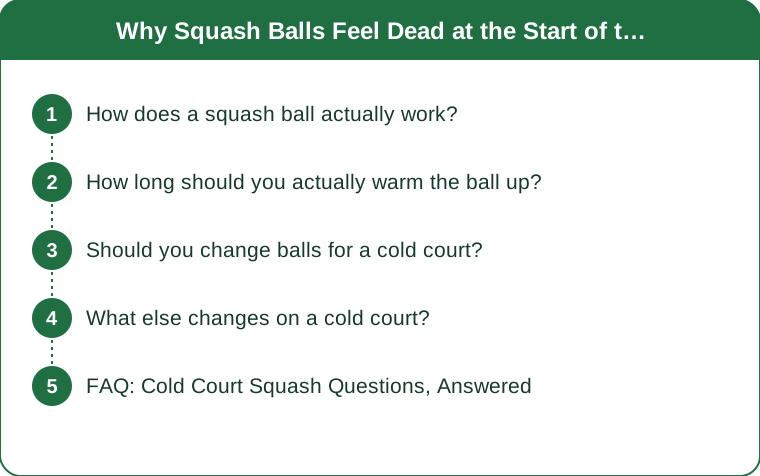
How does a squash ball actually work?
It’s a sealed pocket of air inside rubber, and the air pressure — which rises with temperature — determines the bounce.
Compression heats the air inside. Every time the ball hits a wall it deforms, and that deformation converts kinetic energy into heat. Repeated impacts raise the internal air temperature substantially — a well-warmed ball can reach 45°C or more inside during hard play.
Warmer internal air means higher pressure, which means the ball returns more energy on each bounce instead of absorbing it. A fully warm double-yellow ball bounces roughly twice as high as the same ball cold.
Cold ambient temperature works against this continuously. The ball isn’t just starting colder — it’s losing heat to the surrounding air faster the whole time you play. On a cold court, the equilibrium temperature the ball settles at is lower, so it never reaches the liveliness it had in a warm summer court.
The rubber itself stiffens in cold, which reduces deformation and therefore reduces the heating from each impact. This is a compounding effect: cold ball deforms less, generates less heat, stays cold longer.
Why this hits at the start of the indoor season
Many clubs run courts cooler in autumn — heating hasn’t been turned up, and courts are often unheated spaces that track outdoor temperature with a lag. A court that sat at 22°C in July can be at 14°C in October, and that difference is enormous for ball behavior.
How long should you actually warm the ball up?
Longer than you think, and longer than the standard knock-up allows.
On a warm court, 3 to 5 minutes of solid hitting brings a double-yellow ball to playing temperature.
On a cold court, 8 to 10 minutes is realistic, and it needs to be hard hitting rather than gentle rallying. Soft hitting barely deforms the ball, which means barely any heat generation. The most common warm-up mistake is hitting too gently — a slow rally for five minutes does less for the ball than 90 seconds of hard drives.
Straight drives into the front wall are the most efficient. Hard, low, repeated. Cross-courts and drops don’t compress the ball enough to matter.
Both players should hit hard. A knock-up where one person is drilling and the other is patting is half as effective.
Keep it in play between games. A ball left on the floor for a two-minute break loses a meaningful amount of heat on a cold court. Holding it in your hand or in a pocket does more than people expect.
The practical version
On the first cold sessions of the season, hit hard for five minutes before you even think about starting, then reassess. If the ball is still dying halfway up the front wall, keep going — starting a match with a cold ball produces a match that isn’t representative of either player’s game.

Should you change balls for a cold court?
Often yes, and it’s the adjustment most recreational players resist for no good reason.
The dot system indicates speed, which is really bounce. Double yellow is the slowest and least bouncy, designed for warm courts and strong players who hit hard enough to keep it alive. Single yellow is faster, red faster still, and blue fastest.
Double yellow on a cold court is genuinely unplayable for most recreational players. It requires a level of pace that most players can’t sustain, and the result is short, frustrating rallies where the ball dies before anyone can build a point.
A single yellow or a red dot on a cold court produces rallies much closer to what a double yellow gives on a warm one. This isn’t a downgrade — it’s matching the equipment to the conditions, exactly like using soft-ground studs on a wet pitch.
The ego problem is real and worth naming. Many club players treat the double yellow as the only serious ball and endure poor squash for it. The better players in most clubs are the ones who switch based on conditions.
Progressive balls exist for this — some manufacturers make balls specifically designed for cooler courts or improving players, which sit between the standard categories.
What else changes on a cold court?
Your body, more than your technique, and the injury risk is worth taking seriously.
Muscles need substantially longer to warm up. Squash is explosive — lunging, twisting, rapid direction changes — on cold muscles that haven’t been prepared. The first ten minutes on a cold court is when most squash injuries happen, particularly calf and hamstring strains.
Warm up off court first. Five minutes of movement before you walk on: leg swings, lunges, some easy jogging. This matters more in October than in July, and most players skip it in both.
Layer for the knock-up. A long-sleeve top for the first ten minutes that comes off before the match starts is standard practice among players who’ve been doing this a while.
Grip changes in cold air. Dry, cool air means less hand sweat — which sounds good and often means the grip feels slick differently, since many grips rely on slight moisture for tack. A fresh overgrip at the start of the indoor season is a small, worthwhile reset.
Glass-backed courts run colder than plaster-walled ones and often have a cold spot near the back. Ball behavior can differ between the front and back of the same court on a cold day, which is genuinely disorienting until you know to expect it.
Hydration slips in cold conditions. You sweat as much in a hard cold-court match and feel less thirsty. This is general information, not medical advice — but it’s the reason people cramp in autumn matches more than they expect.
FAQ: Cold Court Squash Questions, Answered
How long should the knock-up be on a cold court?
8–10 minutes of hard hitting, roughly double a warm-court knock-up. Soft rallying doesn’t warm the ball.
Should I switch from double yellow in winter?
For most recreational players on a cold court, yes. A single yellow or red produces far better rallies and doesn’t reflect on your standard.
Does storing the ball somewhere warm help?
A little, and it wears off within a minute or two on court. It’s a small head start rather than a solution.
Why does the ball die faster between games?
It cools while out of play. Keep it in your hand or a pocket during breaks rather than leaving it on the floor.
Is a cold court more injury-prone?
Yes — explosive movement on unprepared muscles is the risk. Warm up off court for five minutes before you step on.
Do new balls behave differently from used ones?
New balls take longer to warm up initially and are generally less lively until broken in over a few sessions.
TL;DR:
- A squash ball’s bounce comes from the temperature of the air sealed inside it, raised by repeated compression
- Cold courts mean a colder start and faster heat loss, so the ball never reaches summer liveliness
- Warm up 8–10 minutes with hard straight drives; gentle rallying barely heats the ball at all
- Switching to a single yellow or red dot on a cold court is matching equipment to conditions, not lowering your standard
- Keep the ball in hand between games rather than on the floor
- Warm up off court first — the first ten minutes on a cold court is the highest-risk period
The ball isn’t dead. The court is cold, and you’re asking a double yellow to do a job it wasn’t built for at 14 degrees.
Keep Reading
This article is for general informational and styling purposes only. Fit, sizing, and product availability may vary.