Why You Lose More Points on the Serve Return Than Anywhere Else
Quick Answer: You play a return on roughly half of all rallies, and it is the one shot where your opponent chooses the conditions and you are furthest from the middle of the court. A weak return hands over the T immediately, so the rally is lost before it has properly started. Most club players practise everything else and treat the return as something that just happens.
The return is not the start of the rally. It largely decides it.
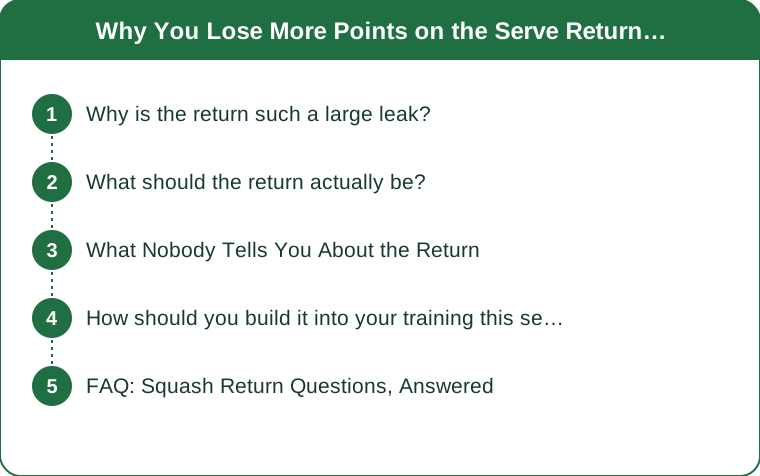
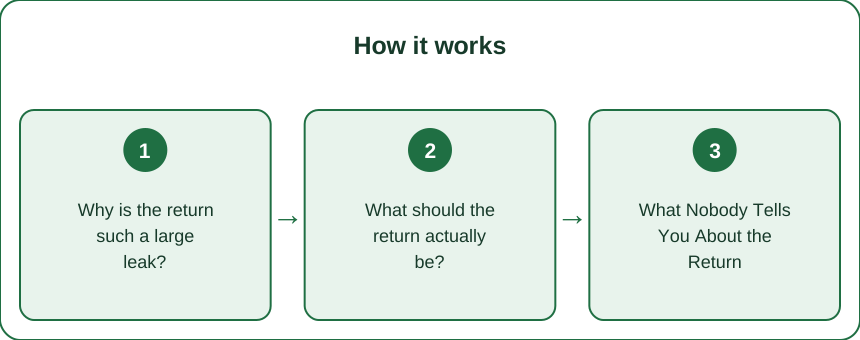
Why is the return such a large leak?
Because of volume, position, and the fact that your opponent sets the terms.
Volume first. You receive serve on about half of all rallies over a match. No other shot except the serve itself comes close to that frequency, and a shot played that often with no dedicated practice is where the largest available improvement sits.
Position second. You start in the back corner, which is the furthest point from the T and the hardest area on the court to hit from. A good serve puts the ball in the back corner behind you, where the wall restricts your swing and the ball dies quickly.
And the server chooses. Height, pace, angle, and target are all their decision. You are responding, and you have less time to read it than in an ordinary rally.
The consequence is compounding. A weak return, typically one that sits in the middle or comes off short, gives your opponent the T and an attacking ball simultaneously. From there you are defending a rally you started level in.
There is a psychological element too. Players treat the return as a formality and then rush it, playing before they have properly set. The rushed return is the single most common way a rally is lost in one shot at club level.
So the return is not a small technical detail. It is roughly half of your rallies, played from the worst position on court, usually unpractised.
What should the return actually be?
A straight length into the back corner, by default, played high enough to be safe.
The default return is straight and deep. It puts the ball where your opponent has to move back and away from the T, and it lets you take the T yourself as they do. This one choice, made consistently, is worth more than any variation.
Height is your friend. A return played too flat clips the tin or sits up. Aim to have the ball crossing above the service line on the front wall, which gives you margin and gets the ball into the back with the least risk.
Volley it when you can. Taking the serve early denies your opponent time to reach the T and keeps you further forward. The volley return is the biggest single upgrade available to most club players, and it is mostly a matter of standing ready to volley rather than backing away automatically.
Move your feet before the ball arrives. Most bad returns are made off a stationary base with the racket taken back late. Set up as the server strikes, not as the ball reaches you.
Variations, used sparingly:
A boast or a drop off the return is worth having occasionally to stop a server serving the same ball every point. Once every several points, not as a habit.
A cross court return is the correct answer to a serve that has genuinely pinned you, and it is a default that gets punished if used repeatedly, because it passes through the middle.
The positioning detail most players get wrong: stand facing the side wall, racket up, not square to the front. From that position you can volley, step back, or move forward without turning first.
What Nobody Tells You About the Return
The serve is the most under practised shot in the game and the return is second. Two shots that between them start every rally, and almost all club practice time goes to drives and drops.
Standing further forward is usually better. Most players stand deep out of caution, which surrenders the volley and gives the ball room to die in the corner. Half a step forward changes what is possible, and it is uncomfortable for two sessions and then normal.
A high return is not a defensive return. It is the percentage shot, and it puts your opponent in the back corner just as effectively as a flat one, without the risk.
Watching the server rather than the ball costs you time. Read the racket face at contact rather than trying to anticipate from body position.
Your return quality drops when your legs go, and it is one of the earliest signs of fatigue in a match. If your returns are getting shorter as the match goes on, that is conditioning showing up in a technical form.
Returning a lob serve is a specific skill. A high, soft serve into the corner is deliberately awkward, and the answer is usually a volley taken early rather than letting it drop into the corner where it dies.
Practising returns alone is possible. Hitting from the back corner into a straight length, repeatedly, is a solo drill that maps directly onto the shot.
How should you build it into your training this season?
Deliberately, and the start of the indoor season is a good moment to do it.
Add five minutes of return practice to every session. Have your partner serve, you return, no rally. Twenty or thirty in a row, from both boxes, and it costs almost nothing in session time. Most players have never done this once.
Practise the serve at the same time, since your partner needs the reps too and the two go together naturally.
Do it before the knock up finishes rather than at the end, when you are tired and the quality drops.
Seasonal points worth noting as the indoor season starts up:
Cold courts change the ball dramatically. A cold ball does not bounce, dies in the back corners much faster, and makes a length return considerably harder to retrieve. Early season courts in autumn are often cold, and the effect on returns is bigger than on any other shot.
Warm the ball up properly and warm yourself up properly. A longer knock up than you would need in July is genuinely necessary, and cold rotational muscles in a game full of lunging is how people injure themselves in the first weeks of a season.
Expect your length to be short for the first few sessions back. This is normal after a summer break and it is a timing issue rather than a technique collapse.
Court booking gets competitive from September onward, so getting a regular slot early in the season is worth doing now.
This is general playing guidance. Squash is demanding on knees, ankles, and the cardiovascular system, and if you are returning after a break, have any history of joint problems, or any heart condition, it is worth a conversation with a doctor before ramping up rather than after.
FAQ: Squash Return Questions, Answered
Where should I stand to receive serve?
Facing the side wall with the racket up, close enough to the service box line to volley if you get the chance. Most club players stand too deep and too square, which gives up the volley automatically.
Should I always return straight?
As your default, yes. Straight and deep moves your opponent off the T and lets you take it. Keep cross court for serves that have genuinely pinned you, and use variations occasionally so you are not entirely predictable.
How do I return a good lob serve?
Volley it if you can, early, before it drops into the corner. Once it is in the back corner off the side wall it becomes very difficult, so the decision has to be made early.
Why do my returns get worse late in a match?
Usually legs. Return quality depends on setting up early, and setting up early depends on being able to move. Deteriorating returns are one of the first visible symptoms of fatigue in squash.
TL;DR:
- You return serve on about half of all rallies, from the worst position on court, and almost nobody practises it.
- Default to a straight, deep, high return that moves your opponent back and lets you take the T.
- Stand a half step further forward, face the side wall with your racket up, and volley whenever the chance exists.
- Add five minutes of serve and return practice to every session, and expect cold early season courts to make length returns harder.
Next time you play, count how many rallies you lose within two shots of receiving serve. That number is your opportunity.
Keep Reading
This article is for general informational and styling purposes only. Fit, sizing, and product availability may vary.