Why You Play Worse Against a Weaker Squash Opponent
Quick Answer: A weaker opponent gives you less pace to work with, hits from unexpected positions, and produces rallies with no rhythm — all of which remove the things a better player relies on. You generate most of your own pace, your timing loses its reference, and the absence of pressure makes you over-hit. It is a pattern problem, not a concentration problem.
You lost the first game 11-8 to someone you have beaten comfortably before, and every error felt like your own.
They were, in a sense. But the reason you made them is worth understanding properly.

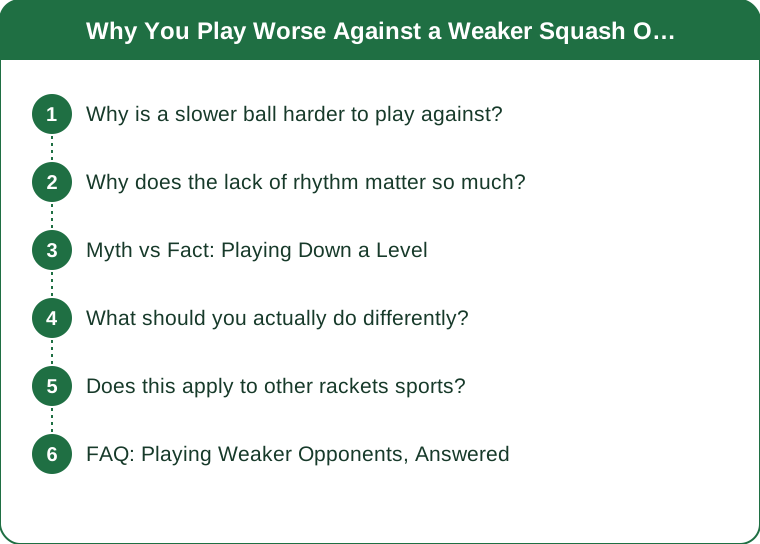
Why is a slower ball harder to play against?
Because you are now generating all of the pace yourself, and that changes everything.
Against a strong opponent, a large proportion of the pace on your shot is redirected from theirs. You are absorbing and steering energy that was already in the ball. It is efficient, your timing is set by the incoming ball, and your swing can be compact.
A weaker opponent hits softer and shorter. Now every shot requires you to create the pace from nothing, with a longer swing and a bigger body rotation.
Longer swings are less accurate. More moving parts, more time for the racket face to drift, more that can go wrong. This is why errors that never appear against good players start appearing against weaker ones.
There is also a timing problem. A slow ball sits up and waits, which sounds easier and is not. Your timing has been trained on a certain ball speed, and a ball that arrives slowly invites you to hit it too early, too hard, or after your body has already started moving on.
The classic symptom is hitting the tin on a straightforward drop you would normally make without thinking.
Why does the lack of rhythm matter so much?
Because rhythm is what allows a good player to stop consciously thinking.
Against an opponent of similar standard, rallies develop patterns. Length, length, boast, drive — sequences repeat, and your movement becomes largely automatic. You are ahead of the ball because you are reading a familiar pattern.
A weaker opponent has no consistent pattern. The shot selection is unpredictable in the least useful way — not tactically unpredictable, but randomly so. A loose ball goes anywhere. You cannot anticipate randomness, so you are reacting to every shot rather than reading the rally.
That has two effects. Movement becomes less efficient, because you are starting later. And your conscious mind stays engaged, which is exactly what degrades performance in a skill you normally execute automatically.
There is also the length problem. Rallies against weaker players tend to be either very short or oddly long and scrappy, with neither providing the sustained even tempo that lets a player settle. Many people report feeling more tired after an untidy match against a weaker opponent than after a hard one against an equal, and this is why.
Myth vs Fact: Playing Down a Level
Myth: you are just not taking it seriously. Fact: reduced arousal is a real factor, but it is not the main one. Players who consciously try harder against weaker opponents often play worse still, because effort applied to a pace-generation problem produces bigger swings and more errors.
Myth: playing weaker opponents makes you worse. Fact: it makes you worse at that match, and it can make you better overall if used deliberately. Playing against someone who gives you nothing forces you to construct points rather than counter-punch, which is a genuinely useful skill and one that better opponents rarely let you practise.
Myth: you should just hit winners. Fact: the winner-hunting response is the most common and the most self-defeating. Trying to end every rally early against a soft ball produces exactly the low-percentage attacking shots that keep the score close.
Myth: it is a mental toughness issue. Fact: the mental component is real and it is largely downstream. You get frustrated because you are making errors; you are making errors because of pace, timing and rhythm. Address the technical problem and most of the frustration resolves on its own.
Myth: warming up properly does not matter for an easier match. Fact: it matters more. An under-warmed body playing an unpredictable, scrappy match with awkward reaching and lunging is a good description of how squash injuries happen, and the perceived easiness of the opponent is what leads people to skip the warm-up.

What should you actually do differently?
Adjust the plan rather than the effort.
Play length, relentlessly. Against a weaker opponent, straight length to the back corners wins on its own. It is the highest-percentage shot in the game, it requires them to play from the position they are weakest in, and it removes the need for you to invent anything.
Shorten your swing deliberately. Resist the pull toward a bigger swing. A compact swing with less pace but more accuracy beats a full swing that finds the tin.
Take the ball earlier rather than harder. Volleying more is the single most effective adjustment. It removes the slow-ball timing problem entirely, it gives your opponent less time, and it keeps you on the T.
Accept longer rallies. Deciding in advance that you will play six shots before attacking removes the impulse to end points early, which is what generates most of the errors.
Move properly between shots. Returning to the T every time, even when it feels unnecessary, maintains the movement pattern that keeps everything else working. Standing and watching is how you end up flat-footed on the one good shot they play.
And use it deliberately. Setting yourself a constraint — only straight drives, or volley everything above waist height — turns a frustrating match into useful practice, and usually improves the result as a side effect.
Does this apply to other rackets sports?
The pattern appears across all of them, and the shared mechanism is worth recognising.
Tennis players describe exactly this against a moonballer or a pusher. Badminton players describe it against someone who lifts everything high. Table tennis players describe it against a defensive chopper.
The common thread: opponents who give you nothing force you to create everything, and creation is riskier than redirection.
Squash has a particular version of the problem because of the confined space and because a loose ball genuinely can go anywhere off the walls. There is also a movement complication that other sports lack — a weaker opponent frequently ends up in your way, and clearing properly is not yet automatic for them. This produces let and stroke situations that break rhythm further and add a layer of decision-making to every rally.
On that point: play it safe. Do not swing through someone who has not cleared. The temptation to hit anyway when you are frustrated by an untidy match is exactly the situation where squash injuries happen, and a let costs a rally while a racket to the face costs considerably more.
The reassuring conclusion from other sports is that this is a well-recognised phenomenon that essentially every competitive player experiences, and that the players who handle it best are the ones who changed their tactics rather than their intensity.
FAQ: Playing Weaker Opponents, Answered
Should I play down a level at all?
Yes, with a purpose. Matches against weaker opponents are the only reliable opportunity to practise constructing points and to work on shots you cannot risk against an equal. Played without a purpose they are frustrating and of limited value; played with a constraint they are among the more useful sessions available.
Why am I more tired after these matches?
Generating your own pace on every shot is metabolically expensive, and reacting rather than anticipating means more movement to cover the same court. Add a longer, scrappier match with more stopping and starting, and a match against a weaker opponent can genuinely be harder work than a tight one against an equal.
How do I stop getting frustrated mid-match?
The most effective approach is to change what you are measuring. Instead of tracking the score, track something you control — the percentage of shots that reach the back third, or how often you return to the T. Frustration in this situation feeds on unmet expectation, and replacing the expectation with a process target usually settles it within a game.
TL;DR:
- A slower ball means you generate all the pace yourself, which requires longer swings — and longer swings are less accurate.
- Weaker opponents produce no rally patterns, so you react rather than anticipate and stay consciously engaged throughout.
- Play straight length relentlessly, shorten your swing, volley more, and commit to longer rallies before attacking.
- Trying harder makes it worse; changing tactics fixes it.
- Warm up properly and be extra careful about swinging near an opponent who has not cleared.
The useful reframe is that this is a tactical situation rather than a character test. You are not losing points because you stopped caring — you are losing them because someone removed the pace, rhythm and predictability your game quietly depends on, and the fix is to stop trying to play your usual match against an opponent who cannot provide the conditions for it.
Keep Reading
This article is for general informational and styling purposes only. Fit, sizing, and product availability may vary.