Why Your Length Gets Shorter as a Squash Match Goes On
Quick Answer: Short length under fatigue is almost never a strength problem. It comes from hitting the ball later as your movement slows, which drops the contact point behind you and takes the height off your drive. Height, not power, is what carries a ball to the back. Fix it by getting to the ball earlier, aiming higher on the front wall as you tire, and accepting a slower, higher rally rather than trying to hit harder.
Game one, everything dies in the corners.
Game three, everything sits up for a volley.
You did not get weaker. You got late.

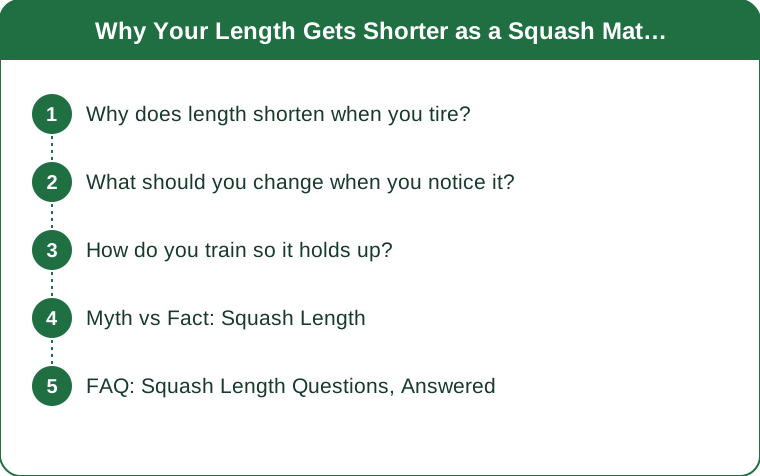
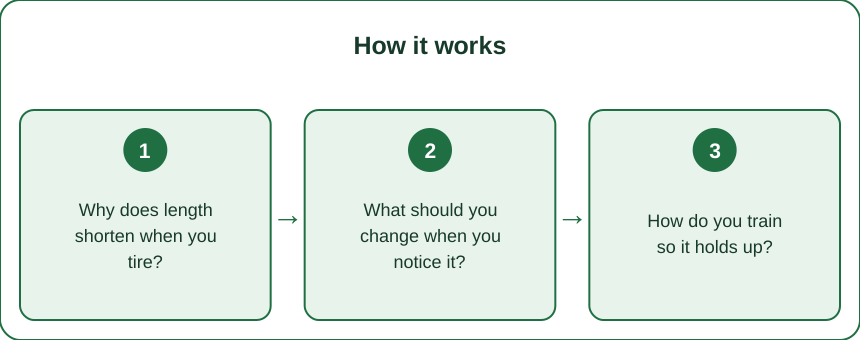
Why does length shorten when you tire?
Because of where you are contacting the ball, not how hard you are hitting it.
Slower movement means later contact. As your legs tire, you arrive at the ball a fraction late. That fraction moves the contact point from beside you to behind you, and a ball struck from behind cannot be hit with the same upward trajectory.
Height is what produces length, not power. A ball hit higher on the front wall travels further before bouncing. Most players respond to short length by hitting harder, which flattens the trajectory and makes it shorter still.
The wrist and forearm tire before the legs. Fine racket control fades faster than gross movement, and the racket face opens or closes slightly without you noticing.
Preparation collapses under fatigue. Racket back early is the first habit to disappear, and a late backswing forces a rushed, flat strike.
The ball itself is a factor. A warm ball is livelier and travels further. Between games, a ball cools measurably, and the first rallies of a new game are genuinely shorter with the same swing.
And the trap: shorter length means your opponent moves you more, which tires you further, which shortens your length again. It compounds within a single game.
What should you change when you notice it?
Six in-match adjustments, in order of immediate effect.
Aim higher on the front wall. The simplest fix and the one nobody uses. If your length is dropping, aim a foot or two higher. It slows the rally, buys you time, and puts the ball back into the corners.
Get to the ball earlier, not faster. Move on your opponent’s strike, not on the bounce. Half a second of earlier movement restores the contact point without requiring more speed.
Prepare the racket the moment you start moving. Not on arrival. Late preparation is what produces a flat, rushed strike.
Play more crosscourt lobs. A high crosscourt to the back is the highest-value shot in a tired game — it resets the rally, moves your opponent to the back, and buys you time to get back to the T.
Slow the pace deliberately between rallies. Take the full time available. Walking back to serve rather than rushing is a legitimate and rules-compliant recovery.
Simplify shot selection. Straight length and crosscourt lob, mostly. Attempting the drop that worked in game one is how tired players lose points, because a short drop from a tired body sits up perfectly.

How do you train so it holds up?
Six things, and the first is what most club players never do.
Practise solo drives while fatigued. Do your court sprints or ghosting first, then hit 50 straight drives on each side. Practising technique fresh trains a skill you already have in the state where you do not need it.
Do targeted length drills with a height target. Mark or visualise a line on the front wall and aim above it. Length is a height habit, and it needs to be trained as one.
Ghost with racket preparation included. Most ghosting is movement only. Adding the full swing shape trains the preparation habit that fatigue erodes.
Build the ability to repeat. Short high-intensity intervals with a technical demand attached — 30 seconds of movement, then 10 accurate drives — mirrors match demands far better than continuous running.
Strengthen the legs eccentrically. Lunges with a slow 3-second lowering phase and split squats. Squash is a deceleration sport, and deceleration is what fails first.
Play games with a length-only condition. Straight drives and lobs only, no drops. It builds both the discipline and the specific endurance for the shot that decides tired matches.
Seasonal note: as courts get colder into autumn, balls warm up more slowly and stay slower for longer. Length that was easy in a warm August court needs noticeably more height in October, and players routinely misread that as a drop in their own game.
Myth vs Fact: Squash Length
Myth: good length comes from hitting hard. Fact: it comes from height and contact point. Hard and flat lands short; medium and high lands in the corner.
Myth: short length means you need to be fitter. Fact: fitness helps, but the immediate cause is a late contact point. Earlier movement and a higher aim fix it in one rally; fitness takes months.
Myth: the lob is a defensive shot only. Fact: a good crosscourt lob is one of the most effective attacking shots in the game against a player who likes to volley, and it is the single best recovery shot available.
Myth: you should play at the same pace throughout. Fact: varying pace deliberately is a core tactical skill, and slowing a rally when you are tired is a decision rather than a concession.
Myth: drops win points. Fact: drops from a tired body, played off a poor position, lose points. In the third and fourth games, straight length wins far more than anything clever.
Myth: a warm-up is about the muscles. Fact: it is at least as much about the ball. An under-warmed ball behaves completely differently, and matches are frequently decided in the first three points by whoever adapted faster.
FAQ: Squash Length Questions, Answered
Why does my length drop after the first game?
Later contact from slower movement, and a cooler ball between games. Aim higher and move earlier rather than hitting harder.
How high should I aim on the front wall?
Higher than feels natural. For a straight length aiming to die in the back corner, most club players aim too low by a foot or more, particularly when tired.
Is it fitness or technique?
Both, but the immediate fix is technique. Contact point and aim height change the next rally; fitness changes the next season.
What is the best shot when I am tired?
Crosscourt lob. It moves your opponent to the back, resets the rally and buys you time to get back to the T.
How do I train this specifically?
Hit drives after conditioning, not before. Fifty straight drives each side while genuinely tired.
Does the ball really change that much between games?
Yes. A cooler ball is significantly less lively. The first rallies of each game are shorter with an identical swing.
Should I stop playing drops when tired?
Mostly. A drop from a poor position with a tired arm sits up, and the counter is usually a winner.
TL;DR:
- Short length under fatigue comes from a late contact point, not from lost strength.
- Height on the front wall produces length — hitting harder flattens the ball and makes it shorter.
- Move on your opponent’s strike, not the bounce, and get the racket back as you move.
- The crosscourt lob is the best tired-player shot in the game.
- Practise drives after conditioning, not before. That is where the skill actually needs to hold.
Next match, when you notice your length dropping, aim a foot higher instead of hitting harder. It works within a single rally.
Keep Reading
This article is for general informational and styling purposes only. Fit, sizing, and product availability may vary.