Why Your Squash Shots Keep Landing Short (and the Fix Beginners Skip)
Quick Answer: Shots landing short in squash usually come from hitting the ball too late (behind the body) or with too flat a swing path, rather than a lack of power — adjusting contact point to slightly in front of the body and adding more racket-head lift fixes most cases faster than simply hitting harder.
New squash players often respond to short shots by swinging harder, which rarely fixes the underlying issue and can actually make control worse.

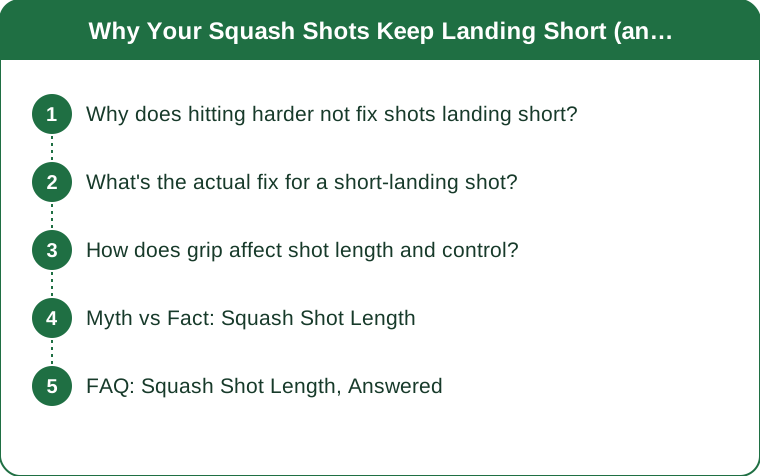
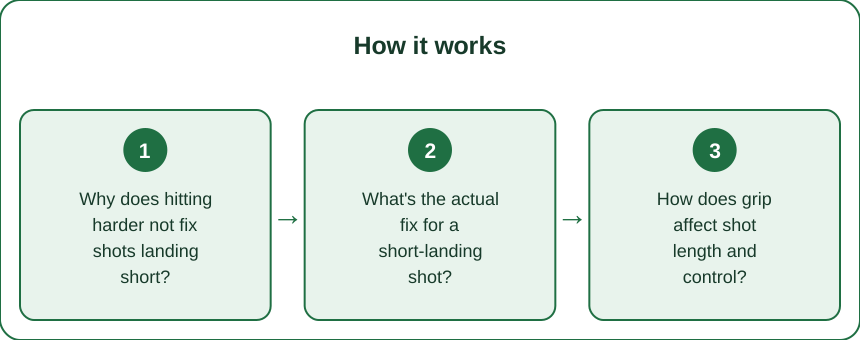
Why does hitting harder not fix shots landing short?
Shot length is determined more by swing path and contact timing than raw power — a flat, late-contact swing sends the ball on a lower, shorter trajectory regardless of how much force is behind it.
More power on a flawed swing path just means the ball hits the front wall lower and comes off faster, often landing even shorter, not longer, since it has less time in the air to travel.
What’s the actual fix for a short-landing shot?
Contacting the ball slightly earlier — more in front of your body rather than beside or behind it — combined with a slightly more upward (lofted) swing path sends the ball on a longer trajectory that reaches deeper into the court.
This is a timing and angle fix, not a power fix, which is why players who make this adjustment often see their shot length improve immediately, even without swinging any harder.

How does grip affect shot length and control?
A grip that’s too tight limits wrist snap at contact, which reduces the racket-head speed and lift needed for a longer, well-controlled shot — a relaxed grip through the swing, tightening only at the moment of contact, generates more usable racket speed.
Grip size itself matters too: a grip that’s too large for your hand limits wrist mobility in a similar way, compounding the same short-shot problem.
Myth vs Fact: Squash Shot Length
Myth: Hitting harder always makes shots go deeper. Fact: Swing path and contact point determine trajectory; power without the right angle often just makes a short shot faster, not longer.
Myth: Only advanced players can hit consistent length. Fact: Length is primarily a timing and technique skill, trainable with focused practice even at a beginner level, and doesn’t require advanced strength or experience.
Myth: A more aggressive follow-through fixes short shots. Fact: Follow-through matters for consistency but doesn’t compensate for a flawed contact point — the fix happens at contact, not after it.
FAQ: Squash Shot Length, Answered
How can I check if I’m hitting the ball too late?
Have a coach or a training partner watch your contact point relative to your front foot — contact meaningfully behind the front foot is a common sign of late timing.
Does racket string tension affect shot length?
Somewhat — looser strings can add a small amount of extra ‘trampoline’ effect, but this has a much smaller impact than swing path and contact timing.
How long does it take to fix a short-shot habit?
With focused drilling (targeting length specifically, not just rallying), many players notice improvement within a few sessions, since it’s largely a timing adjustment rather than a new physical skill.
TL;DR:
- Short shots usually come from late contact and a flat swing path, not lack of power
- Contact the ball slightly earlier and add more upward lift to the swing
- A relaxed grip through the swing (tight only at contact) improves racket speed and control
- This is a timing fix, trainable at any skill level — not primarily a strength issue
Next session, focus on contact point before adding power — most short-shot problems resolve from that single adjustment.
Keep Reading
This article is for general informational and styling purposes only. Fit, sizing, and product availability may vary.