Why Your Squash Shots Lose Power Halfway Through a Match, Not Just Late in It
Quick Answer: Squash’s constant multidirectional movement (unlike steadier-paced sports) depletes forearm and shoulder stabilizer endurance faster than most players expect, often showing up as power loss around the match midpoint rather than only near the very end — this is a specific muscular endurance gap, not a general fitness or skill issue.
You trained your cardio and expected the fade to hit in the final few points if at all. Instead, your shots start losing snap noticeably earlier, right around the midpoint of a long match, well before you’d call yourself ‘tired’ overall.

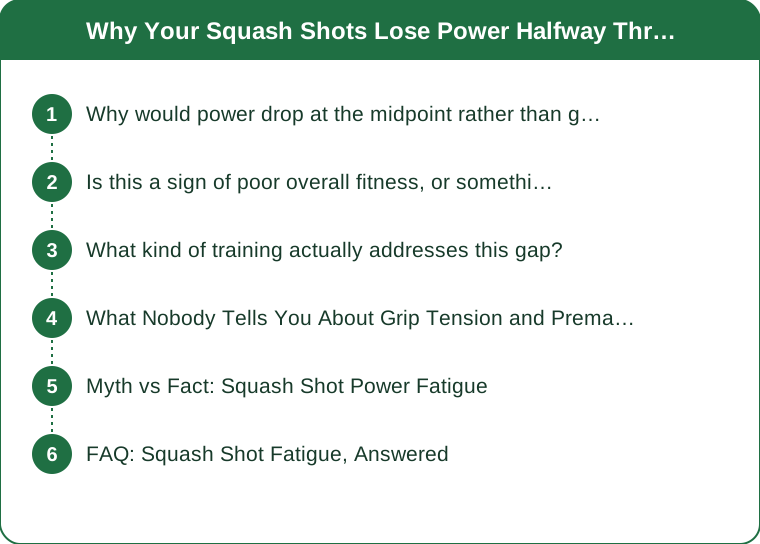
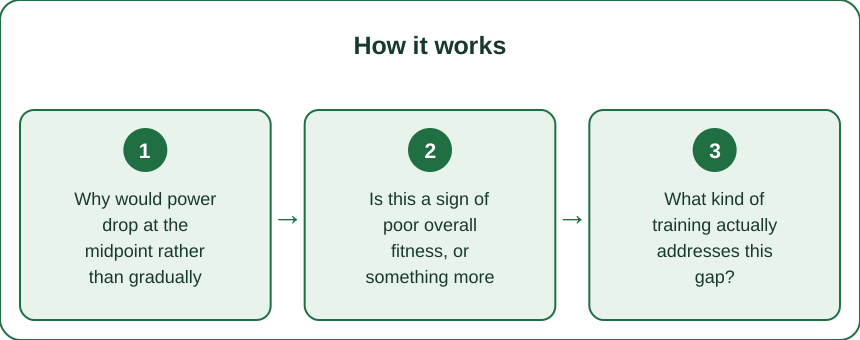
Why would power drop at the midpoint rather than gradually toward the end?
Squash demands constant multidirectional lunging, twisting, and rapid direction changes far more than steady-state cardio sports, and the small stabilizer muscles in the forearm and shoulder — the ones actually generating shot power and control — fatigue on a different timeline than your larger cardiovascular system. Your legs and lungs might feel fine mid-match while those smaller, less-trained stabilizer muscles have already accumulated enough fatigue to noticeably affect shot power.
Is this a sign of poor overall fitness, or something more specific?
It’s usually specific muscular endurance in the forearm and rotator cuff stabilizers, not general fitness — many players with strong cardiovascular conditioning still experience this exact pattern because general cardio training doesn’t specifically build the localized muscular endurance those smaller stabilizing muscles need for match-length repeated swings.
What kind of training actually addresses this gap?
Forearm and rotator cuff endurance work — light-weight, high-repetition exercises (wrist curls, external rotation with resistance bands) done consistently over weeks — builds the specific localized endurance that generic fitness or even squash drilling alone often doesn’t fully address, since match play itself doesn’t isolate and progressively overload those muscles the way targeted exercise does.

What Nobody Tells You About Grip Tension and Premature Fatigue
Here’s a detail rarely coached explicitly: over-gripping the racket harder than necessary, especially under match pressure, accelerates forearm fatigue significantly faster than a relaxed, appropriately firm grip. Many players unconsciously tighten their grip more under pressure or fatigue, which then accelerates the exact fatigue causing their power loss — becoming a self-reinforcing cycle that a deliberately relaxed grip during rallies can interrupt.
Myth vs Fact: Squash Shot Power Fatigue
Myth: Power loss late in a match means you need more cardio training. Fact: It’s often a specific forearm and rotator cuff endurance gap, separate from cardiovascular fitness.
Myth: Gripping the racket tighter gives you more control as you tire. Fact: Over-gripping accelerates forearm fatigue further, worsening the exact problem it’s meant to solve.
Myth: This fatigue pattern means poor overall fitness. Fact: Many cardiovascularly fit players experience it because generic conditioning doesn’t target these specific stabilizer muscles.
FAQ: Squash Shot Fatigue, Answered
How long does it take to build meaningful forearm endurance improvement?
Most players notice a difference after 4-6 weeks of consistent light, high-repetition forearm and shoulder stabilizer work.
Should I change my grip style entirely to fix over-gripping?
Not necessarily — consciously checking and relaxing grip tension between points during matches is often enough without changing your fundamental grip style.
Does racket weight affect how fast this fatigue sets in?
Yes — a slightly heavier racket accelerates forearm fatigue faster, so players experiencing early power loss might benefit from testing a lighter racket option.
TL;DR:
- Midpoint power loss in squash usually reflects forearm and rotator cuff stabilizer fatigue, not general fitness or cardio
- Targeted, light high-repetition forearm and shoulder endurance work closes this gap over several weeks
- Over-gripping under pressure accelerates the exact fatigue causing the power loss — a relaxed grip helps break the cycle
- Racket weight can be a contributing factor worth testing if the pattern persists
Next match, consciously check your grip tension at the midpoint — relaxing it slightly might buy you more shot power in the second half than you’d expect.
Keep Reading
This article is for general informational and styling purposes only. Fit, sizing, and product availability may vary.